

HMRC just picked Salesforce for a decade-long CRM deal. The part I'd copy is how it wrote the requirements
Salesforce announced an up to 15-year, up to £2 billion CRM agreement with HMRC this week. The public procurement notice behind it splits requirements into first-party core capabilities and optional third-party ones, a structure any team choosing or renewing a CRM can borrow.
Most CRM news is about features. This week's biggest Salesforce story was about a contract. On 15 October Salesforce announced that HM Revenue & Customs, the UK's tax authority, has chosen it as its strategic Enterprise CRM provider in an agreement of up to 15 years and worth up to £2 billion.
The headline number got the attention. What caught mine was the public procurement notice behind it, because it shows how a very large buyer described what it needed. I think most CRM teams, public or private, could learn from it.
What Salesforce announced
According to Salesforce's release, the programme will unify HMRC's legacy systems onto one platform with a single view of each taxpayer's interaction history across contact channels. It will use Agentforce, Public Sector Solutions and Marketing Cloud, on top of Data 360. Salesforce says the tax system supports more than 34 million citizens and five million businesses, and links the work to HMRC's goal of 90% digital service delivery by 2030 while keeping support for people who need extra help.
Agentforce will automate routine administration, triage inbound queries, and route complex cases to specialists. Salesforce stresses that human oversight from trained HMRC staff "remains integral to every taxpayer decision". Quantexa, a UK decision-intelligence firm, will provide tools that connect data, spot fraud patterns and give caseworkers real-time risk scores. Salesforce also says it will allocate 15% of its professional advisory work on the programme to UK SMEs.
Resultsense, which covered the deal, noted it could find no matching statement from HMRC or GOV.UK at the time, so the figures in the announcement are Salesforce's. The public procurement listings I checked show a £2 billion award to Salesforce UK Limited, made in September, with an initial term running to 2036 and options to extend, which is how I read Salesforce's "up to 15 years".
The requirement split is the interesting bit
The award notice describes the requirement as split into core and additional capabilities.
Core capabilities must be delivered by the vendor on a first-party basis, meaning software the supplier owns or develops. They are marketing and campaign management, customer management, case management, interaction, channel and messaging management, AI, insights, reporting and intelligence, and the customer experience portal and app.
Additional capabilities can be first- or third-party. They are identity, verification and authentication, secure digital exchange communications, fraud, data and integration management, operational management, knowledge management, and non-compliance management. The supplier also provides professional services the buyer can call on.
I like this because it forces a clear answer to a question most CRM selections fudge: which capabilities must come from the platform itself, and where are you happy to plug in a specialist? HMRC put AI in the core list, which says it expects AI to be part of the platform, not a bolt-on. And fraud sits in the additional list, which is exactly where Quantexa now fits.
Why this matters for the rest of us
Few teams sign deals this large. But almost every team renewing or replacing a CRM faces the same three problems at a smaller scale.
First, scope creep from vendor bundles. Without a written core list, every add-on in the bundle starts to look essential.
Second, integration debt. If you never say which capabilities can be third-party, you end up with point tools nobody planned for, each with its own integration and its own copy of the customer.
Third, exit. A ten-year term, possibly longer, is a long time. Resultsense made the point that terms on data portability and exit will matter as much as the AI in the headline. I agree. The time to plan how you would leave a platform is when you sign, not when you want out.
What I would borrow
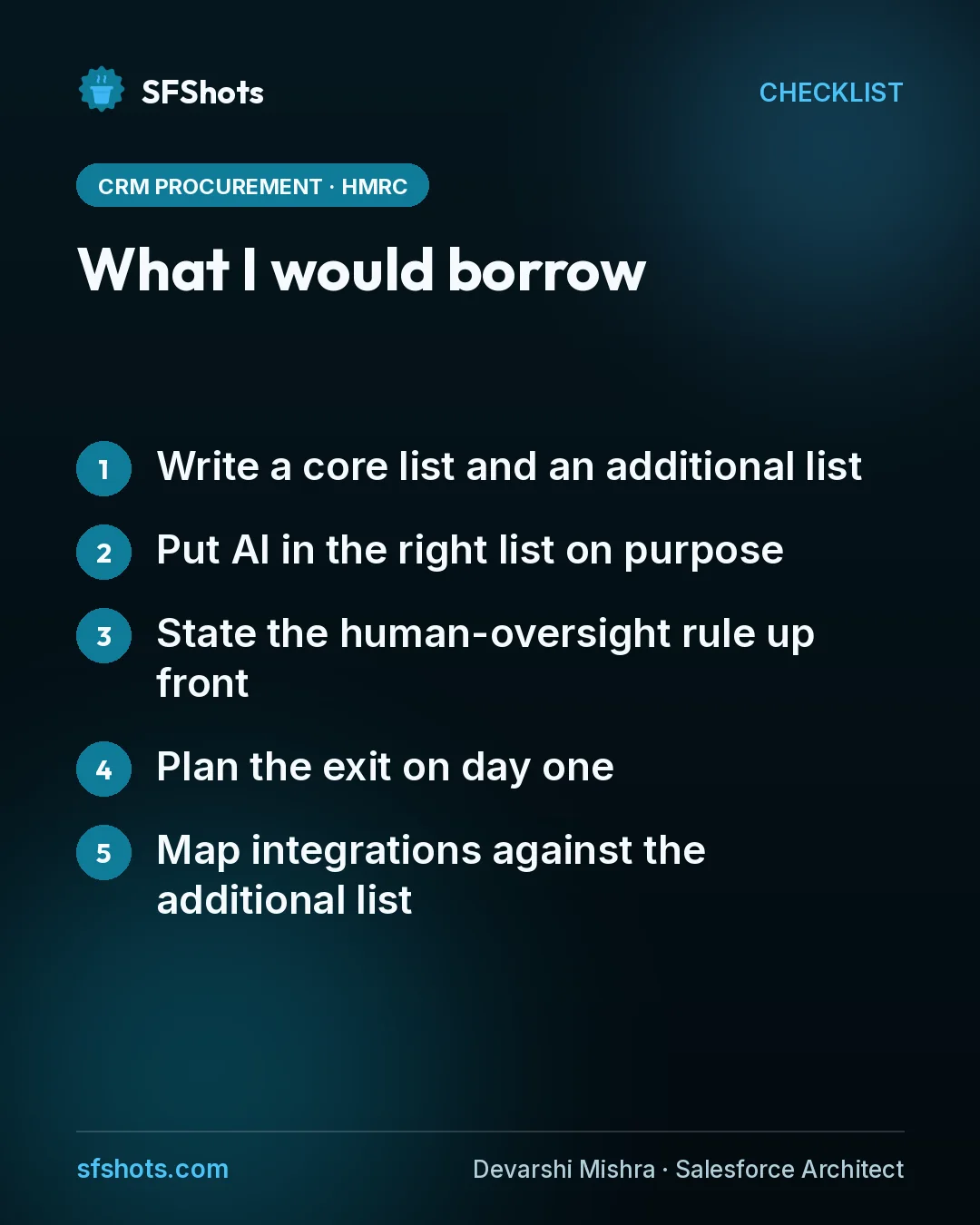
- Write a core list and an additional list. For your own CRM, list the capabilities that must be native and the ones where a third-party product is fine. Agree it with business owners before you talk to vendors.
- Put AI in the right list on purpose. Decide whether AI must be first-party for your use cases, or whether you want the option to bring another model or tool. Either answer is defensible. Not deciding is not.
- State the human-oversight rule up front. HMRC's announcement is explicit that staff stay in every taxpayer decision. Write your equivalent for each agent use case: which decisions an agent can make and which always need a person.
- Plan the exit on day one. Document where your customer data lives, how you would export it, and which integrations depend on platform-specific features. Revisit it at every renewal.
- Map integrations against the additional list. Every additional capability is an integration. Name the owner, the system of record and the data flow for each one.
The takeaway for CRM and RevOps teams
The HMRC deal is a public-sector story, but the procurement notice is a useful template for anyone. Split your requirements into what must be native and what can be plugged in, put AI in that list deliberately, write the human-oversight rule before the first agent goes live, and plan the exit while you still have leverage.
If you are renewing a CRM contract in the next year, try writing those two lists this month. You will learn a lot about what you actually need.