

Hunter brings ZoomInfo and Demandbase data into Salesforce. Write your outbound rules before it goes GA
Salesforce's Hunter outbound agent now has ZoomInfo and Demandbase as flagship data partners, with general availability planned for November. Before switching it on, sales and RevOps teams should decide which data it can use, what it can do alone, and how they will judge its work.
Every outbound agent demo I have seen hits the same wall. The agent is clever, but it can only reason over what is already in the CRM. And in most orgs I work in, the CRM is missing half the buying committee, has stale titles, and knows nothing about what happened at the account this morning.
This week Salesforce made a move aimed straight at that wall. ZoomInfo and Demandbase both announced on 15 October that they are flagship data partners for Hunter, Salesforce's outbound sales agent for Sales Cloud. That is good news. It also means the questions I would normally ask about an enrichment tool now apply to an agent that acts on the data.
What Hunter is
Salesforce introduced Hunter in September as part of a set of "job-ready" Agentforce agents. Salesforce describes it as an agent that works a sales pipeline from research to outreach, collaborating with sellers over weeks and months. It is in pilot now, with general availability planned for November.
Hunter is also the first agent on what Salesforce calls a long-horizon runtime. In Salesforce's example, a seller asks Hunter to rescue at-risk deals before quarter end, and Hunter turns that into a measurable goal, builds a plan, and decides which tasks it can do on its own and which need the seller's approval. Salesforce lists three pieces underneath: memory across sessions, durable execution so plans keep running, and dynamic steering based on each user's feedback.
Salesforce also quotes one customer result: 60% of Perk's sales pipeline is built by its Hunter agent. That is a vendor-reported figure about one customer, so I treat it as a sign of what is possible, not a benchmark.
What the data partners add
According to ZoomInfo's release, Hunter draws on verified company and contact data, intent signals and news from ZoomInfo, with no separate login. ZoomInfo gives examples: spotting that a target account just raised funding or hired a new revenue leader, surfacing contacts who are not yet in the CRM, and drafting outreach for the rep to review. A Salesforce product VP is quoted saying no separate contracts are needed because ZoomInfo ships with Hunter out of the box.
Demandbase's release covers the account side: engagement data, ranked lists of the most engaged people at a target account, visibility into accounts showing intent, and identification of buying group members. Demandbase says this runs through its MCP server, and that it is a featured MCP partner on AgentExchange.
On governance, ZoomInfo's release says Hunter works within Salesforce's permission and approval model, that ZoomInfo data access follows existing ZoomInfo and Salesforce controls, and that organisations can see what the agent did, which data it used, and who approved each action. When a step needs a judgment call, Hunter shows its reasoning and asks the rep first.
Why I would slow down before switching it on
None of this is a reason to wait. It is a reason to prepare. An analyst note on Yahoo Finance made the same point from an investor angle: more agents pulling external data and triggering agreement workflows means more surface area, and trust has to keep pace.
Here is what worries me as an architect. Contacts that "are not yet in the CRM" have to land somewhere. If Hunter or a rep creates them, they arrive with whatever duplicate rules, ownership rules and consent fields you have today. If those are weak, an agent will make the mess faster than any human SDR team could.
Second, "who approved each action" is only useful if someone reviews it. An audit trail nobody reads is decoration.
Third, the approval line matters more than the model. The difference between "Hunter drafts, the rep sends" and "Hunter sends" is a business decision, not a technical one, and it should be made deliberately.
What I would do before November
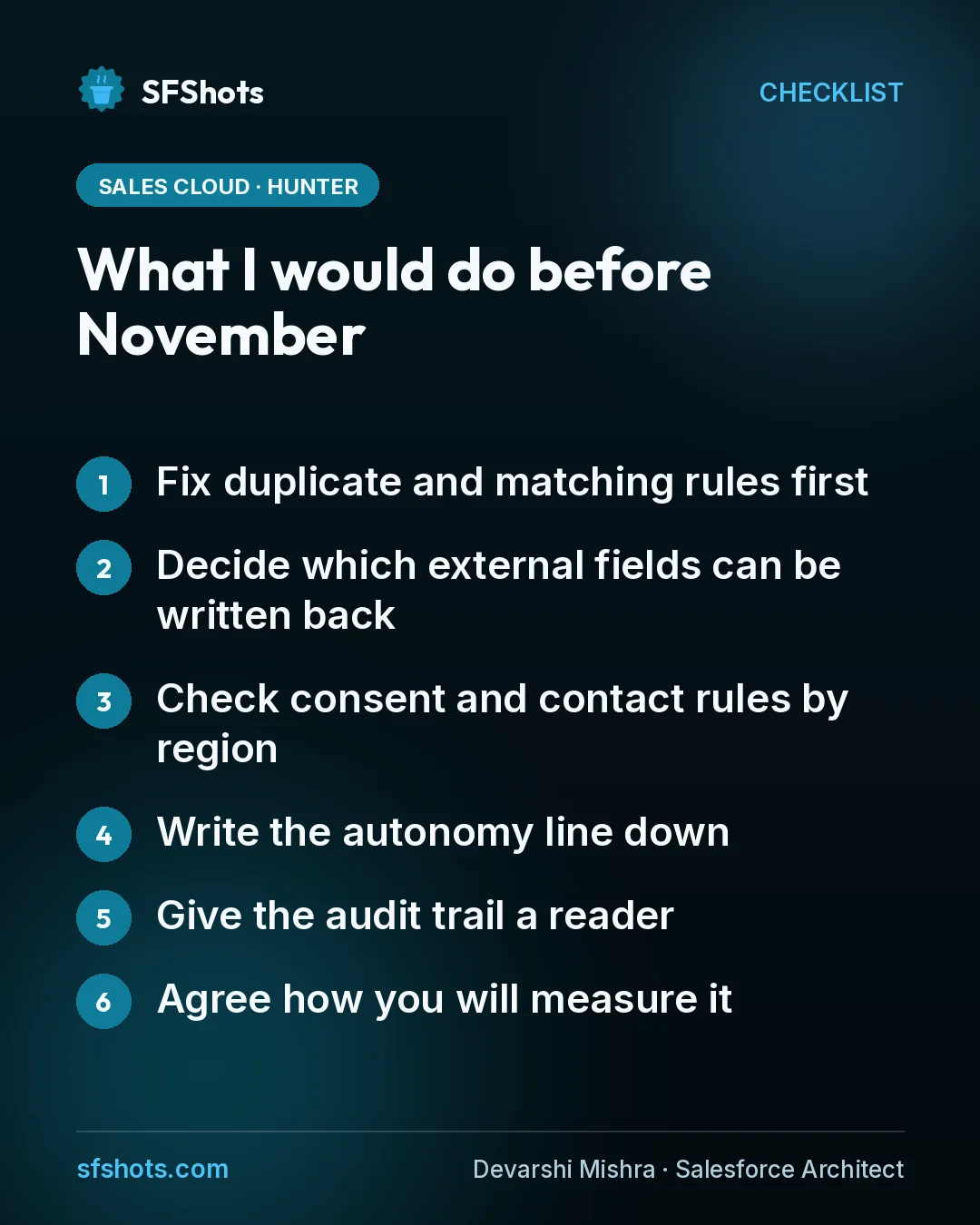
- Fix duplicate and matching rules first. Check how Lead and Contact matching works today. Agent-created records should hit the same rules as everything else, and you want to know your duplicate rate before an agent starts adding to it.
- Decide which external fields can be written back. Enriched data shown to a rep is one thing. Enriched data written over your own records is another. List the fields, and decide whether ZoomInfo or Demandbase values can overwrite what is already there.
- Check consent and contact rules by region. An agent drafting outreach to a newly found contact needs to respect your opt-out and regional rules. Make sure those fields exist and are populated before outreach is drafted, not after.
- Write the autonomy line down. For each Hunter action, say whether it can act alone, needs rep approval, or is off limits. Start strict. Loosen it only with evidence.
- Give the audit trail a reader. Pick an owner, usually sales ops, who reviews a sample of Hunter's actions every week during the first months.
- Agree how you will measure it. Pick two or three numbers before launch, such as meetings booked from agent-drafted outreach and the rep edit rate on drafts. Without a baseline, every review turns into an argument about anecdotes.
The takeaway for CRM and RevOps teams
Hunter puts better external data in front of an agent, and that will make outbound agents genuinely more useful. But the agent inherits your data model, your duplicate rules, your consent fields and your approval habits. If those are shaky, the agent will expose it quickly.
Use the weeks before general availability to do the unglamorous work: clean matching rules, clear write-back rules, a written autonomy line, and a named person who reads the audit trail. Then turn it on for one team, measure it honestly, and expand from there.
Sources
- Business Wire: ZoomInfo Named a Flagship Data Partner for Hunter, Salesforce's New Outbound Sales Agent
- Business Wire: Demandbase Named Flagship Data Partner for Hunter, Salesforce's New Outbound Sales Agent
- Salesforce: Salesforce Expands Agentforce With a New Portfolio of AI Agents Built for High-Value Work
- Yahoo Finance: Salesforce (CRM) Unveils Hunter For AI Powered Outbound Sales