

Docusign now lives inside Agentforce and Slack. Decide what an agent is allowed to commit to
Docusign's agreement platform is now native across Salesforce, Agentforce and Slack, so sellers and AI agents can generate, send and track contracts without leaving the CRM. Before that goes live, CRM and RevOps teams should decide who owns approved terms, where pricing comes from, and which agreement steps an agent may take on its own.
In most Salesforce orgs I have worked on, the contract is the one part of the deal the CRM does not really understand. The Opportunity knows the amount and the close date. The signed PDF knows the payment terms, the renewal notice period and the odd clause legal agreed to at 11pm. Those two rarely agree for long.
This week Docusign and Salesforce announced a change that pushes agreements much closer to the CRM, and to the agents working in it. That is useful. It also means a contract can now be generated and sent from places where, until recently, people only talked about deals.
What was announced
On 13 October Docusign said it is bringing its Intelligent Agreement Management platform natively into Salesforce, Agentforce and Slack, extending a partnership that is more than 20 years old. According to the release, teams will be able to:
- Ask questions about agreements and generate or send contracts from within Agentforce.
- Manage the whole agreement lifecycle inside the CRM, from first draft to signature.
- Connect customer conversations to agreement workflows, with visibility through post-signature archiving.
- Let legal and contract teams review contracts, see renewal details and run post-execution analytics without leaving the CRM.
- In Slack, request a contract, pull live customer and pricing data, apply approved terms and route to legal, all in the thread where the deal is being discussed.
Docusign also says sales teams can use the AI agents they already rely on to track contract terms, surface renewal dates and launch agreement workflows. And it says its capabilities are coming to Slackforce and the Headless Toolkit, the newer agent-first surfaces Salesforce has been talking about.
Two quotes from the release frame the intent. Salesforce's Bill Patterson talks about bringing agreement workflows into Salesforce, Agentforce and Slack "so people and AI agents can turn executing agreements into a competitive advantage." Docusign's Paula Hansen puts it more bluntly: "Agreements are where revenue gets made or lost."
A Yahoo Finance analysis of the Hunter launch tied the two together. It noted that the expanded Docusign partnership lets users manage, generate and track agreements inside Agentforce and Slack, and that more agents triggering Docusign-backed agreements adds to the surface area where trust and uptime need to keep pace.
Why this needs design work, not just a switch
None of this is a reason to hold back. Pulling agreement data into the CRM is exactly what most of my clients have asked for. But three things change when contracts can start from an agent or a Slack thread.
First, "apply approved terms" assumes someone has defined what approved means. In many orgs, the approved clause library lives in a legal team's head or a shared drive, not in anything an agent can check.
Second, "pull live customer and pricing data" raises the question of which pricing. If your org has CPQ or a price book, the answer should be that source, not whatever number was typed into the Slack thread an hour ago.
Third, generating a draft and sending a contract are very different actions. One is a convenience. The other is a commitment made in your company's name. The release describes both, and your org needs to decide where the line sits.
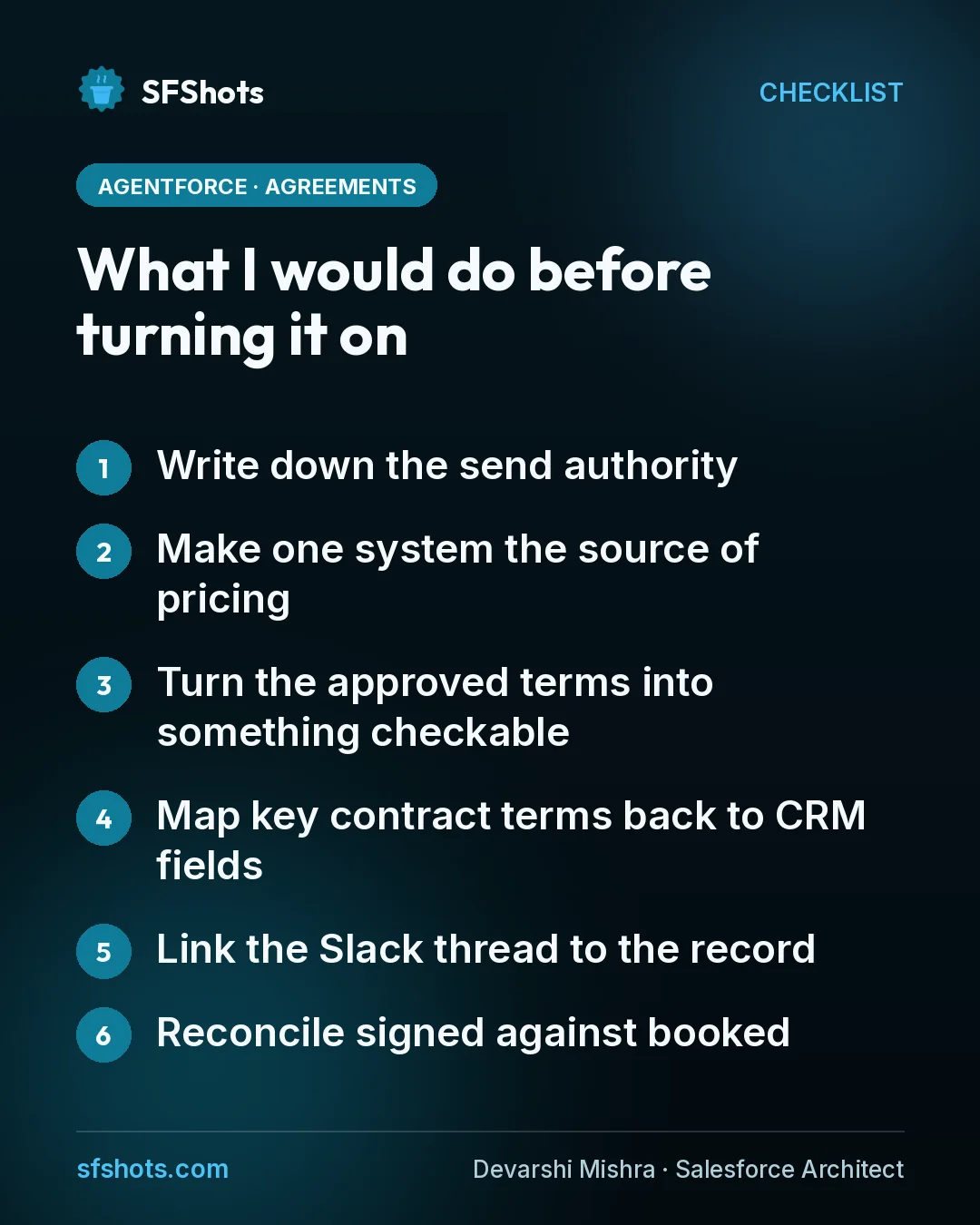
What I would do before turning it on
- Write down the send authority. For each agreement type, decide whether an agent can only draft, can send after a named person approves, or can send on its own. Start with draft-only for anything that commits price or terms.
- Make one system the source of pricing. Agreements generated from Agentforce or Slack should pull price and discount from your price book or CPQ, not from free text. If a discount is outside policy, the workflow should route it for approval before a document exists.
- Turn the approved terms into something checkable. Work with legal on a short list of standard terms and fallback positions. An agent can only "apply approved terms" if those terms are written down somewhere it can read.
- Map key contract terms back to CRM fields. Renewal date, notice period, term length and auto-renewal should land on the Opportunity, Contract or Asset record, not stay buried in a PDF. That is what makes "surface renewal dates" reliable for forecasting and renewal pipelines.
- Link the Slack thread to the record. If negotiation and approvals now happen in Slack, make sure the thread is tied to the Opportunity so the history survives when people move on.
- Reconcile signed against booked. Run a simple monthly check that the signed agreement value matches the Opportunity amount. When agents start generating documents, mismatches will show up here first.
The takeaway for CRM and RevOps teams
Docusign inside Agentforce and Slack closes a gap that has annoyed sales and legal teams for years. Agreements become part of the CRM's working data instead of an attachment.
The catch is that an agent can now move a contract forward in a conversation. So the real project is not the integration. It is agreeing who owns approved terms, which system owns price, and exactly which agreement steps an agent may take without a human. Settle those three things first, start with drafts only, and widen the agent's authority once the signed-versus-booked numbers show you can trust it.