

Salesforce says agents now answer the leads its reps never could. Copy the handoff, not the headline number
A Salesforce sales leader says AI agents have generated more than $88 million by contacting leads that used to go unanswered. Before CRM and RevOps teams copy the idea, they should design the assignment rule, the handoff record and the attribution method, because those are what make a number like that believable.
Almost every Salesforce org I have worked on has a lead problem nobody likes to talk about. Marketing fills the top of the funnel, lead scoring decides who is worth a call, and everything below the line just sits there. The Lead object quietly turns into an archive.
So a number from this weekend caught my attention. A Salesforce sales leader says AI agents have generated more than $88 million in revenue by reaching exactly those leads. I think the idea is worth copying. I just don't think the headline number is the part to copy.
What Salesforce said
Ctech reported on 18 October that Itai Margalit, Area Vice President of Sales for Israel at Salesforce, spoke at the Israel Information Technology Conference 2026 in Tel Aviv. His framing was simple: "At Salesforce, we had 100 million leads, and prior to integrating AI agents, about 75% of them went unanswered."
He said the agent now makes the first contact and "hands off the interaction to a human whenever a personal touch is required." According to Margalit, the work has generated more than $88 million in revenue, and handling the same volume of first responses with people would have needed about 400 more employees.
Ctech was careful to add that Salesforce has not explained how the $88 million was calculated, over what period, or how much of it can be attributed directly to the agents. That caveat is the most useful line in the article for anyone in RevOps.
Margalit also made two points I agree with. "Many AI projects fail because they start from the end, rushing toward results before defining what they actually aim to achieve." And: "You cannot simply keep an organization and its business processes as they are and just layer AI on top."
How the agent actually works
Salesforce described how its own lead agent works in an October 2025 blog post, written a few months after it went live. Historically, only one in four of its leads got a follow-up. The rest scored too low to justify a rep's time, and there were only about 400 sales development reps for millions of leads a year.
The agent was set up with its own account and permissions, and it follows rules of engagement and opt-out preferences. Once a lead is assigned to it, the agent sends personalised emails based on the record, follows up if there is no reply, and, when someone does reply, judges their interest, sends a meeting link and copies the human rep. All of that activity lands in the lead's activity history. Every email said up front that it came from Agentforce.
The lessons in that post are more practical than the numbers. The out-of-the-box prompts were too generic, and the team had to ground them in product content. The team also moved from counting activity to measuring pipeline generated, meetings booked and opportunities created. And Salesforce described a hybrid role where one human SDR oversees 15,000 leads a month instead of 500.
Agibank's customer story shows what a good handoff looks like. When a prospect is ready, the rep receives the conversation history, the customer's questions, an assessment of interest and recommended next steps. The agent also checks whether a transfer is permitted before routing the conversation to a sales queue.
What I would design before switching it on
None of this is hard to configure. The hard part is the operating model around it. This is the list I would work through with a client.
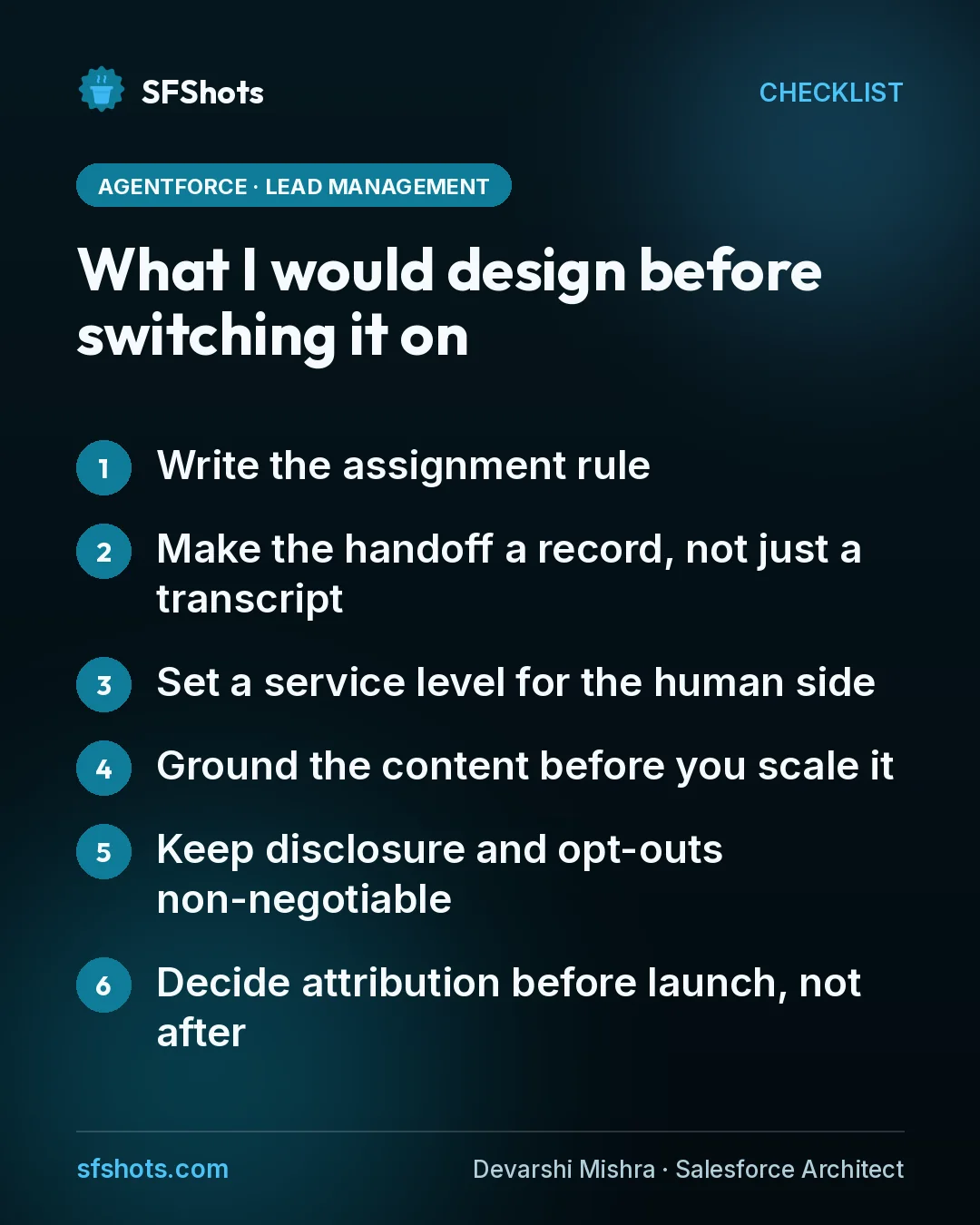
- Write the assignment rule. Salesforce pointed its agent at the leads humans were not working. Decide explicitly which leads go to the agent, which go to people, and what moves a lead from one to the other. If that rule lives only in someone's head, reps and the agent will end up emailing the same person.
- Make the handoff a record, not just a transcript. A rep should not have to read a whole email thread to find out what the prospect wants. Agree a short set of handoff fields: interest level, the questions asked, the product of interest and a suggested next step. Store them on the Lead or a related record so reports can use them.
- Set a service level for the human side. An agent that replies in minutes is wasted if the rep picks up the handoff three days later. Put a time limit on accepting handed-off leads and report on breaches.
- Ground the content before you scale it. The generic-prompt lesson is worth taking seriously. Give the agent approved product content and test its emails against real lead records in a sandbox before it touches production.
- Keep disclosure and opt-outs non-negotiable. Salesforce made every email say it came from Agentforce and had the agent respect opt-out preferences. I would treat both as launch requirements, not polish.
- Decide attribution before launch, not after. This is the part the $88 million story is missing. Add fields that record whether an agent made first contact and when it handed off, then agree with finance how agent-sourced pipeline and revenue will be counted. If a rep closes a deal the agent opened, write down whose number it is.
The takeaway for CRM and RevOps teams
The real lesson here is not "agents make money". It is that the leads you have written off are probably your cheapest pipeline, and an agent finally makes it affordable to work them.
But a revenue claim is only as good as the data behind it. Before you turn on an outbound or nurture agent, agree three things: which leads it owns, what a handoff must contain, and how you will count what it produces. If you get those right, you will be able to report your own number with a straight face, including the period it covers and how much of it the agent really earned.