

Salesforce job demand fell 13% while Agentforce skills rose 63%. Plan your CRM team by skill, not by cloud
10K's latest Salesforce ecosystem report, covered by Salesforce Ben, shows overall demand down 13% and demand for Sales, Service and Marketing Cloud roles falling while Agentforce skills climb. For CRM and RevOps leaders, the useful response is a skills-based plan for 2027: agent design, governance, data and integration, and the business judgement to choose between options.
Most of the Salesforce team plans I have seen are organised by cloud. There is a Sales Cloud person, a Service Cloud person, someone who looks after Marketing Cloud, and a developer or two who handle integrations when things get complicated.
The latest job market numbers suggest that structure is getting old. I don't read them as a reason to panic. I read them as a prompt to plan the next year by the skills the work now needs, not by the product names on the licence.
What the report says
Salesforce Ben published a summary on 16 October of this year's Salesforce Ecosystem Report from 10K. The headline is that global demand for Salesforce jobs fell 13%, after an 8% increase the year before.
10K has also changed how it measures demand. It now tracks demand by product rather than by role, which makes it easier to see where the decline sits. According to the summary:
- Demand for Sales Cloud roles is down 13%.
- Demand for Service Cloud roles is down 21%.
- Demand for Marketing Cloud roles is down 28%.
- Demand for Agentforce skills is up 63% year on year globally, including 87% in North America and 132% in India.
- Tableau is still the largest single demand category, appearing in 15% of job postings, but that is down 32% year on year.
North America was the only major region that grew, up 3%, and it now accounts for half of global demand. India fell 11%. Meanwhile the number of consulting partners listed on AppExchange reached 4,247, up 14%, with almost all the growth in small firms. Firms with one to five certified experts grew 32% and now make up more than half of all partners. Salesforce Ben also notes that this year's report did not include supply figures.
10K's founder, Nick Hamm, put it this way: "Though 2026 looks like the first year AI is substituting for labor in the Salesforce ecosystem, the need for talent isn't going away." The report's advice to professionals is to "move up the stack and into complexity", with a focus on agent design and governance. Salesforce Ben adds a fair caveat: many Agentforce projects still can't get past the pilot stage, and adoption was one of the biggest barriers discussed at Dreamforce.
Why I read this as a skills shift
The pattern makes sense from where I sit. A lot of standard configuration work is exactly what AI tools now help with. What they don't do well is decide what an agent should be allowed to touch, connect it reliably to the systems around Salesforce, or explain to a sales director why one option is better than another.
That last point stood out in the Salesforce Ben piece. It highlights knowing how to guide stakeholders through a busy landscape of solutions to find the right one. In my experience, that is where most projects succeed or fail, and it is a business skill as much as a technical one.
Aventary, which helps B2B sales teams with Salesforce RevOps and AI strategy, made a related argument on the same day. It suggests auditing every open or budgeted Salesforce role before the next planning cycle and putting each one in one of three groups: builder or configurator, admin with AI fluency, and architect or integration specialist. Its view is that the first group faces the most pressure from AI, the second should be trained or hired selectively, and the third should be protected. I would not apply that mechanically, but it is a useful way to start the conversation.
What I would do with a CRM team plan for 2027
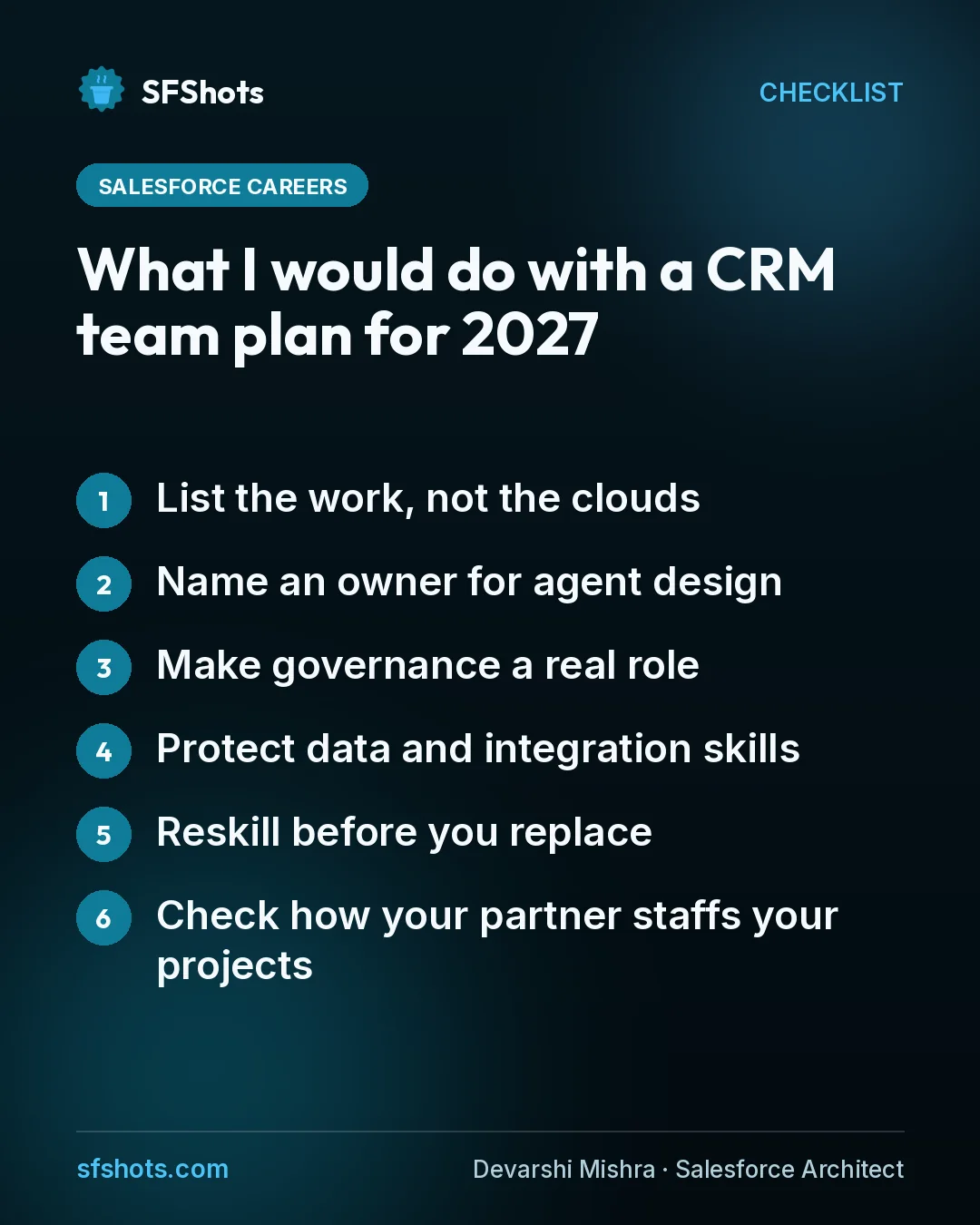
- List the work, not the clouds. Write down the jobs your team actually does each month: changes to flows, new integrations, data fixes, access reviews, reporting requests, agent tuning. Then see which of those are growing and which AI tools are already shrinking.
- Name an owner for agent design. Someone needs to own the instructions, actions and test cases for every agent in your org. If that is nobody's job today, it is the first gap to fill.
- Make governance a real role. Permissions for agent users, review of agent changes, monitoring and cost tracking are ongoing work. Give them to a named person with time set aside, not to whoever is free.
- Protect data and integration skills. Agents are only as good as the records and systems they can reach. The people who understand your data model and your integrations become more valuable as more work runs through agents, not less.
- Reskill before you replace. Your current Sales Cloud or Service Cloud admins already know your processes better than any new hire. Training them in agent design and testing is often faster than hiring for it.
- Check how your partner staffs your projects. If your implementation partner still sends developer-heavy teams for work that is now mostly design, testing and governance, ask them to explain the mix.
The takeaway for CRM and RevOps teams
A 13% fall in demand sounds bad, and for some roles it is. But the same report shows the work moving rather than disappearing: away from product-by-product configuration and towards agents, data and the judgement needed to run them safely.
So before your 2027 budget is set, re-plan the CRM team by skill. Make sure someone owns agent design, someone owns governance, and your data and integration knowledge is protected. Then invest in the people you already have, because they understand how your business really works, and that is the part no agent brings with it.