

Voice agents are getting fast enough to sell. Decide what they write back to your CRM
Salesforce AI Research showed Launa-Omni, a voice model that forms a visible text reply before it speaks, and monday.com launched Harmony, a voice sales agent with native CRM write-back. As voice agents start handling real calls, CRM and RevOps teams need to decide what those calls are allowed to change in the record and how anyone will check it.
Most of my integration work ends at the same place: something outside Salesforce wants to write to a record. An ERP updates an order, a marketing tool updates a lead, a telephony system logs a call. The hard questions are never about the API. They are about which fields the outside system is trusted to change, and how you find out when it gets something wrong.
Two announcements from 19 October made me think voice agents are about to become one of those outside systems, and a busy one.
What was announced
Salesforce AI Research published a post on Launa-Omni, a voice model built for real-time, two-way conversation. Its core is a text model retrofitted for audio, so speech and language share one model, and a separate in-house text-to-speech model speaks the reply. Salesforce says it was developed and trained for experiences in Salesforce and Slack, and that it is significantly smaller than other leading voice models.
The design choice I care about is this one. Salesforce says Launa-Omni "produces a text response before anything is spoken, so the reply is visible at the moment it is formed and teams can inspect and correct it." The post contrasts that with speech-to-speech models, where the trade-off can be "less visibility into how a reply was formed, making errors harder to inspect and correct." Salesforce also says the model can be fine-tuned to better handle named entities, dates, alphanumeric IDs and industry jargon, and that it can be paired with a frontier model for requests that need longer reasoning.
The post reports benchmark scores, including 90.60% on VoiceBench and a 72.9% macro score on τ³-Voice, a test of voice-based customer-service tasks across retail, airline and telecom. Those are Salesforce's own published results. It does not give a release date for customers, and it says Slack users can already try a simplified version through Slackbot Voice Dictation.
The same day, monday.com launched Harmony, a voice agent platform for enterprise sales teams. According to the press release, Harmony runs the full sales cycle on calls, "from prospecting, discovery, and qualification to objection handling, pitching, and warm transfers to live reps with a full briefing." It lists built-in consent and compliance controls and "native CRM write-back", and says it integrates with major CRM platforms. Each of its small models is dedicated to a single job, such as qualifying leads or capturing data.
The release quotes a UK car finance broker, Bright Car Finance, saying the agent now follows up with every approved applicant right away, qualifies about half of its conversations and hands 80% of those to human advisers live. That is one customer's account in a vendor press release, so I read it as an example rather than a benchmark.
Why this is a CRM problem, not a telephony problem
A human rep on a call takes notes, then decides what to update. A voice agent with write-back does both in one step, at whatever volume you point it at. Salesforce's own Service Cloud team made the volume point on the same day, arguing that personal AI agents will call businesses repeatedly and around the clock.
So the record becomes the place where voice mistakes land. A misheard account number, a wrong date or a budget figure the prospect never actually said all end up in fields that drive routing, forecasting and reporting. That is why I think Salesforce's text-first design matters more than the benchmark scores. If there is a text version of what the agent understood and said, you can check it. If there isn't, you are trusting audio nobody will ever replay.
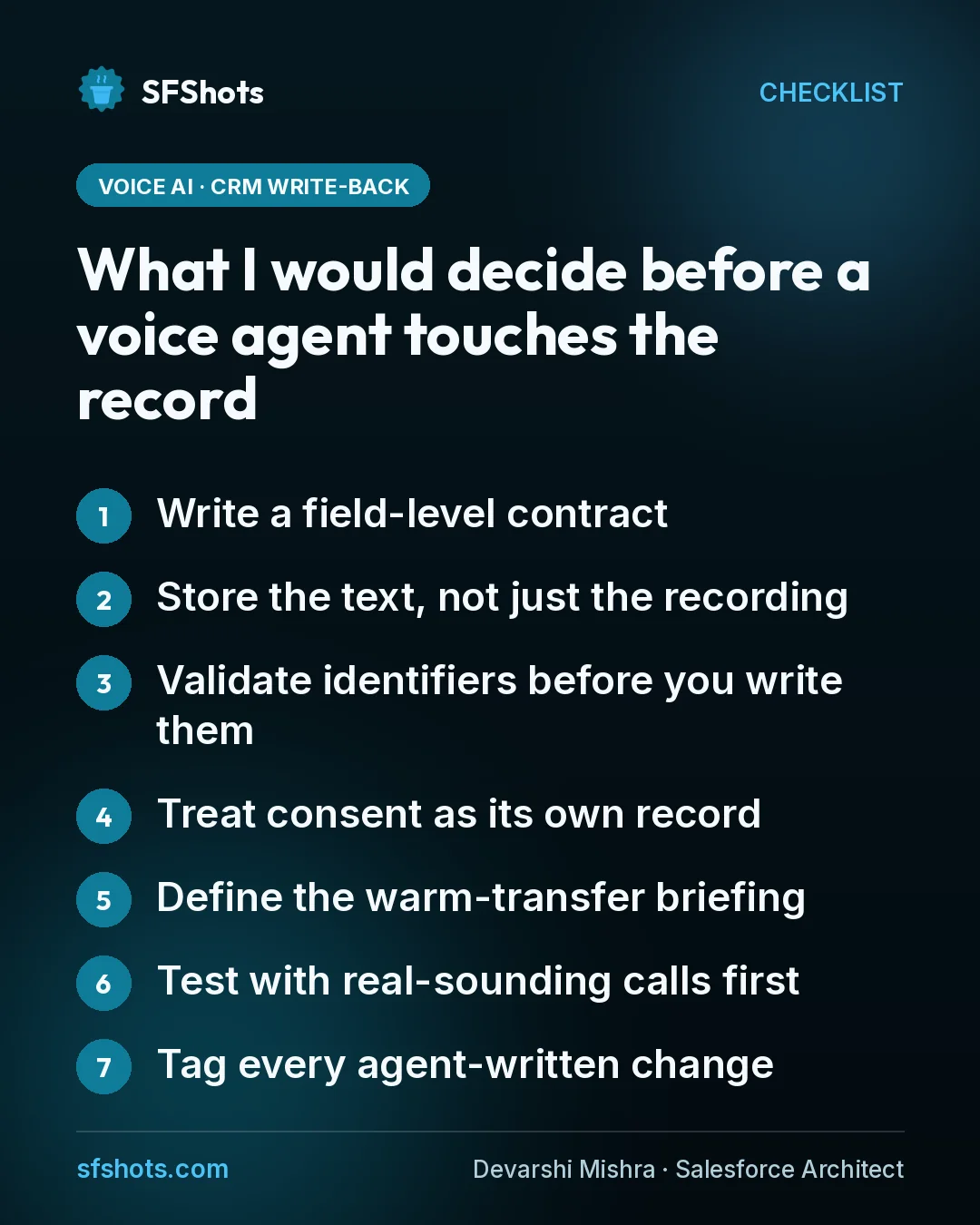
What I would decide before a voice agent touches the record
This is the checklist I would use, whatever vendor you pick.
- Write a field-level contract. List the fields a voice agent may create or update, and the fields it may only suggest. Contact details and call outcome are usually safe. Stage, amount, close date and consent are not things I would let it change on its own.
- Store the text, not just the recording. Keep the transcript and the agent's reply text on, or related to, the activity record. Without it, nobody can explain later why a field changed.
- Validate identifiers before you write them. IDs, emails, dates and phone numbers are where speech goes wrong. Check them against existing records, and have the agent read them back to the caller before saving.
- Treat consent as its own record. Harmony lists consent controls as a feature. Whatever you use, record consent and opt-outs explicitly and make the agent check them before it calls.
- Define the warm-transfer briefing. "A full briefing" should mean the same fields every time: why they called, what they qualified on, open questions and what the agent promised. Agree that list with the reps who will receive it.
- Test with real-sounding calls first. Salesforce points to simulated test calls in Testing Center before an agent takes a live one. Whatever your stack, run scripted calls with awkward names and long IDs in a sandbox and compare what was said with what was written.
- Tag every agent-written change. Use a dedicated integration user or a source field so you can report on, and if needed roll back, what the voice agent changed.
The takeaway for CRM and RevOps teams
Voice agents are getting fast and cheap enough to make calls nobody on your team has time for. That is good news. But each of those calls is now a write to your CRM, so treat the agent like any other integration: a narrow list of fields it can change, a text record of what it heard and said, validation on the values that matter, and a tag on every update. Settle those before the first live call and your pipeline data stays something you can trust.