

Salesforce is buying Braze for $5.66B. Don't freeze your Marketing Cloud roadmap while you wait
Salesforce agreed on 20 October to acquire Braze for about $5.66 billion, with the deal expected to close in fiscal 2028, which starts in February 2027. There is no combined roadmap or pricing yet, so CRM and marketing ops teams should keep building and use the waiting time to map who owns each customer message, from signal to send.
Every time Salesforce buys something big, the same question comes up with the teams I work with: "Should we stop what we're doing until we know what this means?" I expect to hear it a lot this week.
My answer is no. A pending acquisition is not a roadmap. But the months before it closes are a good time to fix something most marketing stacks never write down: which system decides when a customer gets a message, and which system actually sends it.
What was announced
On 20 October, Salesforce said it had signed a definitive agreement to acquire Braze, the customer engagement platform, for approximately $5.66 billion in enterprise value. Braze Class A shareholders will receive $47.50 in cash per share. CNBC reported that Braze shares had closed at $30.04 the day before and rose more than 51% on the news.
Salesforce describes Braze as built for real-time, high-volume B2C engagement. Its event-streaming architecture updates customer profiles and adjusts journeys as people browse, buy and use apps, across mobile apps, websites, email, SMS, WhatsApp and more. Braze serves approximately 2,770 customers, including Canva, Instacart and Venmo.
The press release says Braze is expected to complement all four layers of Salesforce's architecture: Data 360, Customer 360, Agentforce and SIForce. Within Customer 360, it is expected to strengthen Marketing Cloud's cross-channel personalization. Both companies say they share "an open, composable approach". Braze CEO Bill Magnuson said, "we'll continue building as Braze."
The timing matters most. The deal is expected to close in Salesforce's fiscal year 2028, subject to Braze shareholder approval and regulatory approvals. Salesforce's fiscal year ends on 31 January, so fiscal 2028 begins in February 2027. Until then, as CMSWire points out, Braze remains an independent public company.
For context, CNBC notes this comes months after Salesforce agreed to buy Fin, the AI customer service company, for about $3.6 billion. CMSWire also points out that the Braze price is more than double the roughly $2.5 billion Salesforce agreed to pay for ExactTarget in 2013, the deal that became the base of Marketing Cloud.
What we don't know yet
CMSWire's coverage is clear on this: Salesforce has not published a combined product roadmap. The announcement does not say how Braze will sit alongside Marketing Cloud's existing email, mobile and journey tools, or whether pricing and packaging will change.
MarTech's Constantine von Hoffman put the practical question well. Customers will need to know "which system owns journey orchestration, which handles messaging, where the customer profile lives". He also warns that consolidation can "move the complexity behind one logo without reducing it."
I agree, and I'd add that nobody outside Salesforce can answer those questions for you today. What you can do is answer them for your own org, so that when the roadmap does arrive, you can read it against a clear picture instead of a vague one.
Why I'd treat this as an integration question
From where I sit, Braze plus Marketing Cloud plus Data 360 plus Agentforce is a lot of systems that can each decide to contact a customer. Braze already does AI decisioning on content, offers, channels and timing. Salesforce wants to connect it to Agentforce. Your CRM has its own automation on top.
CMSWire reported that Braze launched several agentic tools at its Forge conference in late September, all in beta. One, Operator Connect, lets marketers build Braze campaigns from tools like Claude, ChatGPT and Copilot, running under each user's existing Braze permissions, with send and launch approvals kept inside Braze for now. That is a sensible design. It is also one more place where a campaign can start.
When several systems can trigger a message, the failures are predictable: a customer who opted out in one tool still gets an SMS from another, or a churned customer gets a win-back offer and a renewal reminder on the same day. None of that is new. More automation just makes it happen faster.
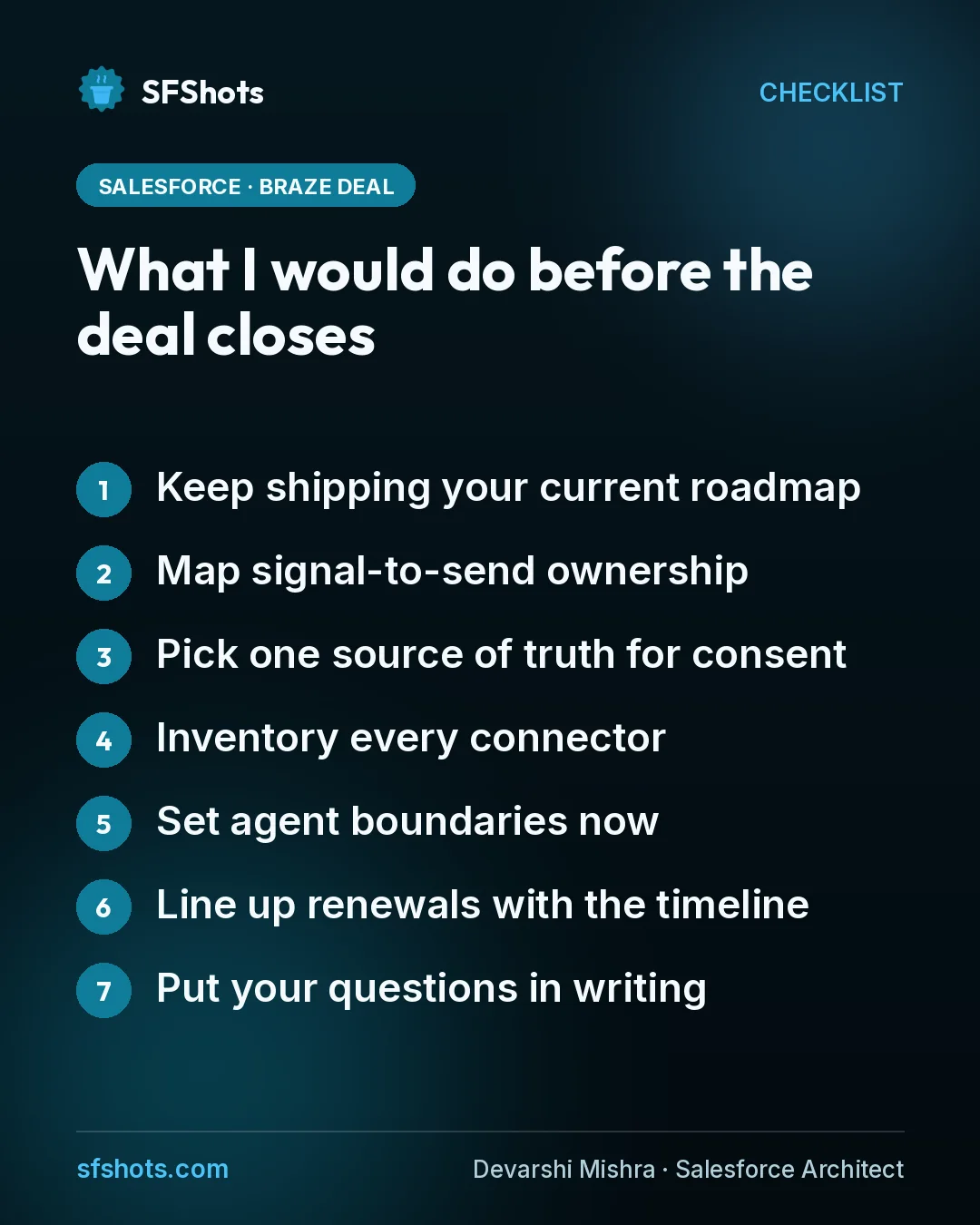
What I would do before the deal closes
This is the checklist I'd run this quarter, whether you use Braze, Marketing Cloud or both.
- Keep shipping your current roadmap. Don't pause work that delivers value now on a deal that is not expected to close before February 2027.
- Map signal-to-send ownership. For each message type, write down which system detects the signal, which decides, and which sends. One owner per decision.
- Pick one source of truth for consent. Opt-outs and channel preferences should live in one place and sync outward, not be edited in three tools.
- Inventory every connector. List each sync between Braze, Marketing Cloud, Data 360 and your CRM: objects, direction, frequency and owner.
- Set agent boundaries now. Decide what AI decisioning and agents may choose on their own, such as send time or channel, and what needs a human approval.
- Line up renewals with the timeline. Check when your Braze and Marketing Cloud contracts renew relative to a fiscal 2028 close, and avoid long commitments you can't revisit.
- Put your questions in writing. Ask your account team about roadmap, packaging and the composable commitment, and keep the answers on file.
The takeaway for CRM and RevOps teams
Salesforce buying Braze will probably change your marketing stack eventually, but not this quarter, and nobody can yet tell you how. The teams that come out of this well will be the ones that already know who owns each customer message, where consent lives, and what their agents are allowed to decide. That work pays off whatever the combined product looks like, so start it now instead of waiting for a slide deck.
Sources
- Salesforce News: Salesforce Signs Definitive Agreement to Acquire Braze
- CNBC: Salesforce announces $5.66 billion deal for Braze
- CMSWire: Why Is Salesforce Buying Braze, and What Happens to Marketing Cloud?
- MarTech: Will Salesforce's Braze deal bring clarity or chaos?
- Salesforce Investor Relations: Investor FAQs (fiscal year end)