


Salesforce Agent Evals beta lands in November. Set your quality bar and kill-switch owner first
Salesforce has put dates on Agent Evals for Agent Fabric, with a beta in November 2026 and GA in January 2027, plus a kill switch that evaluations can trigger. The tool can test your agents, but it can't decide what "good" looks like or who stops an agent. Here's what I'd settle first.
Salesforce announced Agent Evals, API Evals and new cost controls for Agent Fabric yesterday. Agent Fabric is MuleSoft's control plane for agents on any platform, not just Agentforce. The headline is that an agent whose quality drops can now be caught and stopped automatically, before customers notice.
I like the direction. But one thing stood out in the docs. The tool runs the tests and pulls the lever. Your team still has to say what a passing answer looks like, and who is allowed to take an agent offline. Those two decisions take longer than any setup screen, so I'd start on them now, before the beta opens.
What was announced, and when
From the Salesforce announcement on 27 October:
- Agent Evals generates tests before deployment, then evaluates agents, LLMs and MCP servers in production against quality thresholds you define. When results fall short, it triggers predefined interventions, including the Agent Kill Switch, with approval where your policy requires it. Beta in November 2026, GA in January 2027.
- API Evals generates functional and performance tests from API specifications, to catch breaking changes before agents hit them. Same dates.
- Custom Agent Scanner extends discovery to internal systems and platforms behind firewalls. Beta now, GA in January 2027.
- Agent Kill Switch is GA now. The Triggered-Agent Kill Switch, which connects failed evaluations to the switch, is GA in January 2027.
- FinOps Dashboard, Model Wallet and Cost Optimization Policies are GA now. Salesforce says the optimization policies cut token usage by up to 75% in test scenarios.
VentureBeat's coverage is a useful reality check. Agent Evals was first announced at Dreamforce in September, the basic kill switch went GA in September, and several of the cost features were outlined over the summer. What's new is mostly the dates. VentureBeat also points out that the 75% figure is a vendor test result, not a promise about your bill, and that there's no separate public price for Agent Evals or API Evals yet.
Why I care about this as a CRM architect
Salesforce gives a retail example. A team moves its order-support agent to a cheaper model. Scheduled evaluations then find it giving wrong answers about delayed orders. The system asks for approval to quarantine the agent, the team fixes the instructions, reruns the tests on the cheaper model and puts it back. VentureBeat rightly notes this is an illustrative scenario, not a reported customer result. Still, it's exactly the kind of change I see teams make: a model swap, a prompt tweak, a new action.
Salesforce also says fewer than half of organizations with agents evaluate them on live traffic. In my experience, most teams test an agent once, in a sandbox, with questions the builder wrote. That's a demo, not a test.
The catch is in the word "thresholds". An evaluation is only as good as the bar you give it. For a service agent, is 90% correct on order status good enough? Does a wrong refund amount count the same as a slightly off tone? MuleSoft's Andrew Comstock told VentureBeat that evaluations can also check how an agent communicates, so an upbeat agent doesn't suddenly turn sarcastic. Someone on your side has to write that down as a rule.
The kill switch is real, but read the fine print
The MuleSoft docs on containing rogue agents show the plumbing matters more than the button.
- You need Omni Gateway 1.13.5 or later, and both policies go on each model proxy you want to protect.
- Each agent must be registered with a unique instance name and ID.
- Agents must be set up as service identities in your identity provider. Their tokens have to include the agent's identifier and the person the agent is acting for.
- In the current flow, quarantine starts only after a human reviews the flagged activity. It's reversible, and the audit log records the agent instance ID, the user who acted, the timestamp and the environment.
- The Rogue Agent Detection policy uses extra inference calls, so it adds token cost.
VentureBeat adds one more point I'd underline. Blocking an agent through the gateway doesn't necessarily stop every process running on the external platform that hosts it. MuleSoft's own blog says the switch also revokes tokens and blocks credentials at the identity layer. Either way, an agent with a shared integration user, or one that doesn't route through the gateway, is outside the switch's reach.
That ties back to something I wrote last week about agent identity. If your agents still borrow a human login, you can't quarantine one without locking out a person.
The question nobody asks: where do customers go?
When an agent is quarantined, the conversations it was handling don't disappear. If your service agent goes offline at 9 PM, where does the next chat land? In Salesforce terms, that's an Omni-Channel routing question, and a staffing one. I'd rather answer it in a planning meeting than during an incident.
What I'd do before the beta opens
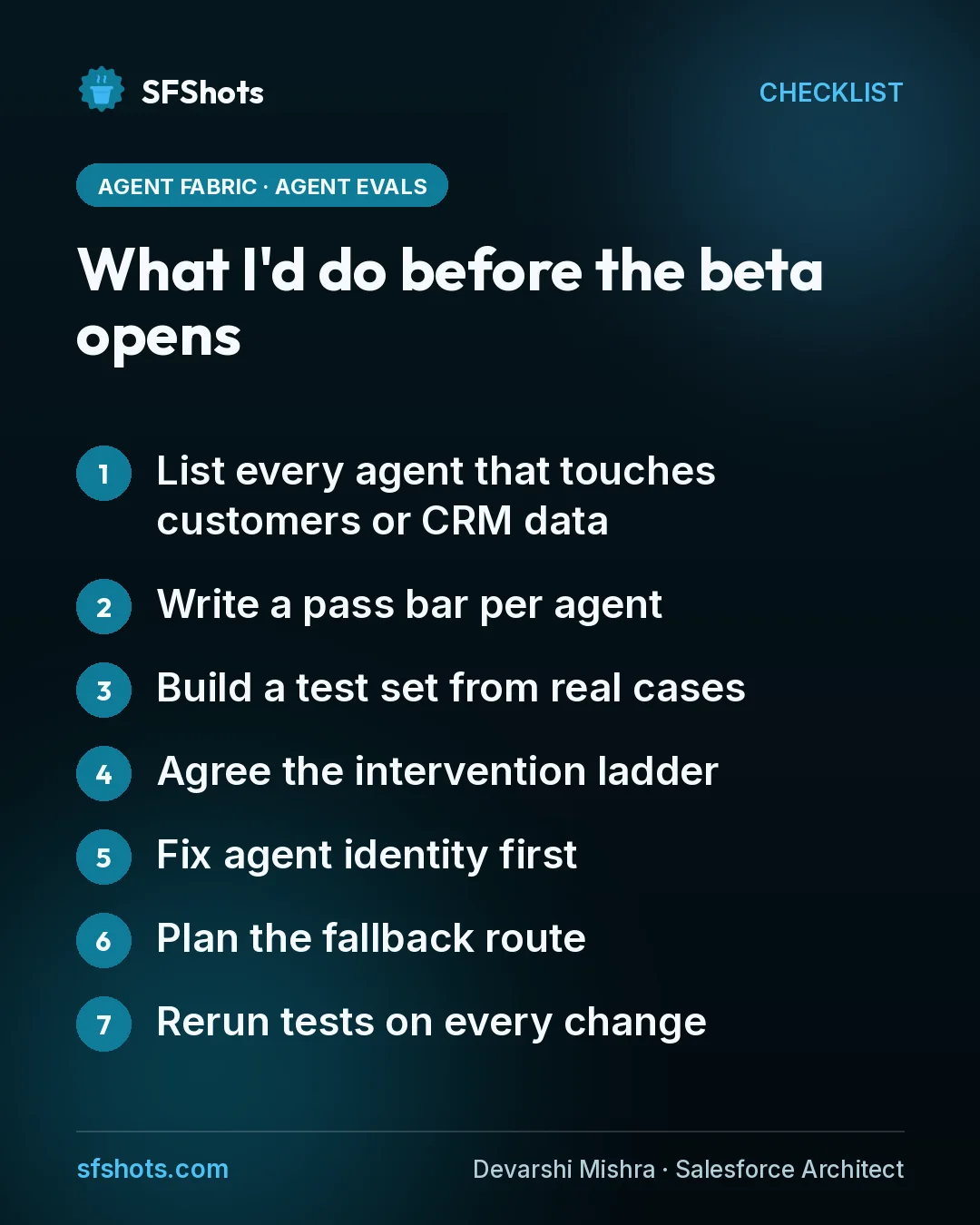
- List every agent that touches customers or CRM data. Name an owner for each, including agents built outside Agentforce.
- Write a pass bar per agent. Pick the top intents, define a correct answer, and set what counts as a fail.
- Build a test set from real cases. Pull past cases and chats, not questions the builder made up.
- Agree the intervention ladder. Decide when to alert, when to ask for approval and when to quarantine, and who approves.
- Fix agent identity first. Give each agent its own service identity and route its traffic through the gateway.
- Plan the fallback route. Decide where customers go when an agent is offline, and test it.
- Rerun tests on every change. Treat a model swap, prompt edit or API change like a release.
The takeaway
For CRM and RevOps teams, Agent Evals is a sign the market is moving from "launch an agent" to "run an agent". That's good news. But a dashboard can't tell you whether a wrong delivery date is a minor slip or a reason to pull the agent. Write your quality bar, name your owners and plan the fallback now. When the beta opens in November, you'll be configuring decisions you've already made, not making them under pressure.
Sources
- Salesforce News: Salesforce Expands Agent Fabric to Automatically Stop Runaway Costs and AI Agent Failures Before They Impact Customers (27 Oct 2026)
- VentureBeat: Salesforce expands Agent Fabric with AI evaluations to trigger shutdowns when agents fail (27 Oct 2026)
- MuleSoft Documentation: Detect and Contain Rogue Agents
- MuleSoft Blog: Stop Agents When They Step Out of Line: New Controls for Autonomous AI