

Salesforce is buying Cresta for a reported $2.7B. Map your voice stack before the deal closes
On 2 November Salesforce signed a deal to buy Cresta, whose voice agents take complex customer calls end to end. It isn't expected to close until Salesforce's fiscal Q1 2028, and the product details aren't out yet. Here's the voice-stack map I'd build now, so you can judge the roadmap when it lands.
On Monday, 2 November, Salesforce announced it has signed a definitive agreement to acquire Cresta. Salesforce calls it "the voice-first operating system for customer experience." Cresta's voice agents take complex customer calls end to end, and the same platform coaches human representatives in real time and analyses every interaction.
Salesforce didn't disclose a price. The Information reported $2.7 billion, citing a person familiar with the deal. Whatever the number, this is a big bet on the phone call, and it lands in the part of the stack that most Salesforce teams know least: the contact center.
I spend my working life integrating other systems with Salesforce, and voice is where I see the messiest seams. So my reaction isn't "what will Salesforce build?" It's "do you know what you run today?"
What Salesforce actually announced
Here's what's on the record from the announcement:
- What Cresta does. Voice agents that "resolve complex customer calls end to end", plus real-time guidance for human reps and analysis of every interaction, on one platform.
- Who uses it. Salesforce names Marriott, Comcast and Alaska Airlines as brands it runs for at enterprise scale.
- Where it goes. Together with Service Cloud, Salesforce says businesses will be able to connect every conversation to the customer and to the outcome: "resolution, retention and revenue."
- What stays open. After the deal closes, Cresta "will continue to support the leading contact center and telephony platforms its customers rely on today."
- When. The deal is expected to close in the first quarter of Salesforce's fiscal year 2028, subject to regulatory approvals. CellCog notes that quarter runs from February to April 2027.
Kishan Chetan, who runs Agentforce and Service Cloud, put the reasoning simply: "Voice is where service is hardest to get right, and where it matters most to customers."
Why this matters even if you already use Agentforce Voice
Salesforce already has a voice story. Agentforce Voice went generally available this year, and the Salesforce Admins blog describes it as a channel, not a separate product. It runs on Salesforce Voice (formerly Service Cloud Voice), which connects your telephony provider, Amazon Connect or one of 20+ supported CCaaS partners, to Salesforce. The same post is blunt: if your org is on a standalone Avaya or Genesys setup with no Salesforce Voice integration, "that's the first conversation to have."
Cresta comes at it from the other side. Salesforce says it will keep working with the contact center and telephony platforms its customers already use.
So for a while, Salesforce will have two routes into the phone channel, and the announcement leaves the important details out. As CellCog points out, it doesn't say whether Cresta becomes part of Agentforce or keeps its own name, and it doesn't say how long Cresta will support platforms that compete with Salesforce. Pricing and packaging aren't out either.
That's normal for a deal that hasn't closed. But it means nobody, including your account team, can tell you yet what the combined product looks like. What you can do is make sure that when they can, you already know your own starting point.
The decision: map your voice stack now
In most orgs I've worked with, nobody owns the full picture of voice. The telephony team owns the phone numbers and routing. The service team owns the case process. Someone in IT owns the integration. Quality and coaching tools often sit with operations, bought separately. Transcripts and recordings end up wherever each tool decided to put them.
That's fine until a vendor offers to replace half of it. Then the question "what would this change?" takes weeks to answer.
Here's what I'd put in the map:
Every voice tool, in one list. Telephony, IVR, any voice bot, transcription, quality scoring and coaching. Include the ones the service team bought on a card.
What each one writes to Salesforce. Cases, tasks, call records, transcripts, summaries, scores. Note the integration user and the fields. This is where the surprises live.
Where recordings and transcripts sit. Which system holds them, for how long, and who is allowed to see them. Voice data is personal data, and retention rules don't change because a vendor did.
The handoff. When a bot or IVR passes a call to a person, what does the rep see? Agentforce Voice, for example, passes the transcript and a prepopulated case. If your current setup passes nothing, write that down.
The calls worth automating. Pick two or three call types where the answer already lives in Salesforce. Measure them today, so any future voice agent has a baseline to beat.
Contract dates. Put telephony, voice AI and Service Cloud renewals in one place, next to the expected close window.
What I'd do this month
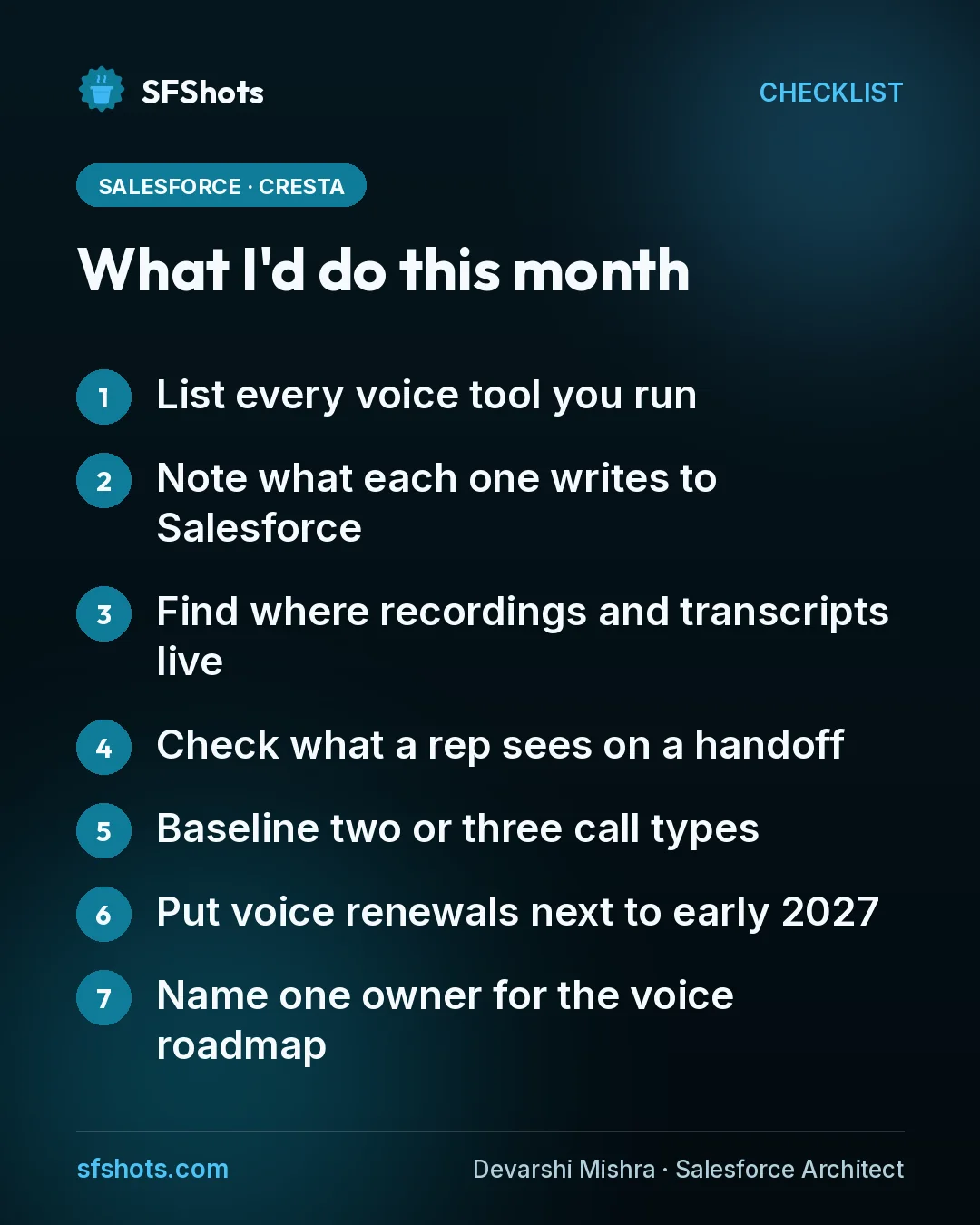
- List every voice tool you run. Telephony, IVR, bots, transcription, QA and coaching.
- Note what each one writes to Salesforce. Objects, fields and the integration user.
- Find where recordings and transcripts live. Include retention and who can access them.
- Check what a rep sees on a handoff. Transcript, summary, case, or nothing.
- Baseline two or three call types. Volume, handle time and resolution today.
- Put voice renewals next to early 2027. Know which contracts come up before the deal closes.
- Name one owner for the voice roadmap. Someone who spans service, telephony and IT.
The takeaway
For CRM and RevOps teams, this deal is a signal that the voice channel is moving into the CRM conversation, and that more of your customer data will start in a phone call. Don't freeze your plans while you wait for the product details, and don't sign anything big on a guess either. Spend a few days mapping what you run, what it writes and who owns it. When Salesforce does publish the roadmap, you'll be able to judge it against your own stack in an afternoon, not a quarter.
Sources
- Salesforce: Salesforce Signs Definitive Agreement to Acquire Cresta (2 Nov 2026)
- Dealroom: Salesforce to acquire AI contact centre startup Cresta for $2.7B (citing The Information)
- CellCog: Salesforce Buys Cresta for a Reported $2.7B, Explained (3 Nov 2026)
- Salesforce Admins: From Chat to Calls: Introducing Agentforce Voice (15 Jun 2026)